
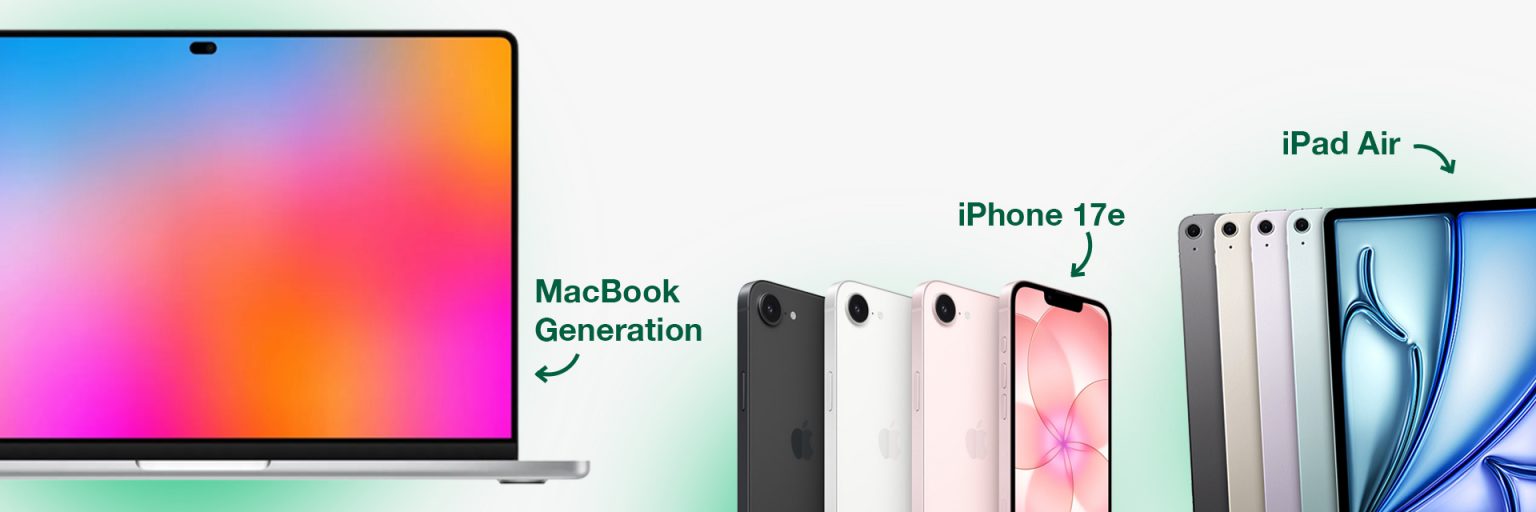
In early March 2026, Apple unveiled several new devices—and in doing so, set a clear technological focus: more processing power, significantly enhanced AI capabilities, and even tighter integration of mobile and desktop workflows.
With the iPhone 17e, the iPad Air with M4, and the new generation of MacBooks featuring M5 chips, Apple is once again demonstrating how mobile devices are increasingly evolving into full-fledged work platforms.
Below is an overview of the most important technical innovations—and how they compare to previous generations.
iPhone 17e – More Power, More Storage, More Connectivity
With the iPhone 17e, Apple’s entry-level model in the current iPhone generation gains a significantly more powerful foundation. At its heart is the new A19 chip, which offers noticeably higher performance and better energy efficiency compared to the previous-generation A18 processor.
Of particular technical interest is the new C1X modem architecture, which enables significantly faster mobile connections and ensures more stable 5G performance.
Key technical skills
- A19 SoC with improved CPU and GPU performance
- 8 GB of RAM for more demanding mobile workflows
- 48-MP camera with 4K video and Dolby Vision recording
- MagSafe support for accessories and wireless charging
- Apple Intelligence Support for Local AI Features
Improvements over the previous model
Compared to the iPhone 16e, the new model offers three key improvements:
- Significantly more powerful chip (A19)
- Improved connectivity thanks to a new Apple modem
- MagSafe integration, which was previously missing
As a result, the iPhone is increasingly becoming a fully-fledged mobile work tool—for tasks such as communication, mobile document creation, photo and video editing, and AI-powered assistant functions.
iPad Air (M4) – Tablets and laptops are converging even further
With the M4 chip, the new iPad Air is the first to feature an architecture that was previously reserved primarily for high-end computers.
According to Apple, the new chip delivers significantly higher processing power and improved graphics performance while maintaining energy efficiency.
Technical Highlights
- Apple M4 chip with a significantly faster GPU
- up to 30% more processing power compared to the previous generation
- expanded memory for multitasking
- New Apple network chips for faster wireless connections
Compared to the previous generation of the iPad Air
Die Unterschiede sind vor allem in drei Bereichen spürbar:
Performance
The M4 delivers significantly higher multi-core performance and greater memory bandwidth.
Multitasking
More RAM enables more complex workflows—such as working with multiple apps at the same time.
Connectivity
New network chips improve data transfers and the speed of features like AirDrop.
With this move, Apple is positioning the iPad Air more firmly as a productivity device that bridges the gap between tablets and laptops—especially when paired with keyboard and Pencil accessories.
MacBook Air with M5 – the new standard for mobile performance
The biggest performance boost is seen in the new generation of MacBooks. For the first time, the MacBook Air features the M5 chip, Apple’s latest notebook CPU.
Der Chip bringt gegenüber dem M4 spürbare Fortschritte bei CPU-, GPU- und AI-Leistung.
Performance improvements over the M4
- up to 15% more CPU performance
- up to 30% higher GPU performance
- Up to 45% faster ray-tracing graphics
- AI computations more than four times faster
In addition to the chip, other system components have also been improved:
- 512 GB of base storage instead of 256 GB
- faster SSD architecture
- Wi-Fi 7 and Bluetooth 6 for modern networks
- higher maximum storage options
SSD performance has also been significantly improved—according to Apple, read and write speeds are up to twice as fast as on the previous model.
What this means for everyday work
This increasingly positions the MacBook Air as a high-performance business notebook for:
- Software development
- Creative workflows
- AI-powered applications
- Data-intensive applications
In particular, the massively increased AI compute performance shows where Apple’s device platform is heading.
MacBook Pro with M5 Pro and M5 Max – a new performance class
The MacBook Pro models have also been updated and now feature the new M5 Pro and M5 Max chips.
These chips are designed for particularly compute-intensive applications such as:
- Software engineering
- Video production
- 3D rendering
- Machine learning workloads
Among other things, the new generation delivers:
- Up to 30% more CPU performance
- Significantly stronger GPU performance
- 4× faster processing of AI prompts
With this, Apple continues the trend of making workstation performance available in mobile devices.
Apple’s strategy: AI-ready devices
A clear focus is evident across all new devices:
The hardware is consistently designed for AI workloads.
From the new A and M chips to improved GPUs and Neural Engines, Apple’s architecture is aimed at running AI computations locally on the device—rather than exclusively in the cloud.
This development is crucial for:
- Data protection
- Real-time assistance features
- High-performance offline workflows
Especially in enterprise environments, this creates new opportunities for AI-powered productivity directly on the workplace device.
Conclusion: A new generation for the Apple workplace
With the 2026 device generation, Apple is consistently expanding its platform in three areas:
Performance
New chip generations deliver significantly more computing and graphics performance.
AI capabilities
The devices are more prepared than ever for AI workloads.
Mobility
Notebook and tablet hardware is increasingly reaching desktop-level performance.
This makes the Apple workplace a high-performance, mobile, and future-proof platform for many companies.
Apple workplace with TKD
TKD supports companies in strategically building and optimally operating the Apple workplace—from device selection and lifecycle management to integration into existing IT structures.
As part of our Device-as-a-Service models, companies receive Apple devices as a fully managed workplace solution—including provisioning, operations, replacement, and sustainable lifecycle management.
Please feel free to contact us—we will advise you on how your company can make optimal use of the new Apple device generation.