
TKD2030 outlines TKD’s long-term commitment to evolving sustainable business practices into a core component of modern mobile IT strategies. The focus is on continuously optimizing LifeCycle processes, responsibly managing resources, and integrating digitalization, economic efficiency, and sustainability across the entire device LifeCycle.
This is based on transparent ESG and sustainability standards, international certifications, and the active development of sustainable service and workplace concepts for companies in Europe. At the same time, the TKD sees itself as an advisory partner for customers, partners, and stakeholders when it comes to aligning mobile IT infrastructures to be future-proof, efficient, and responsible.
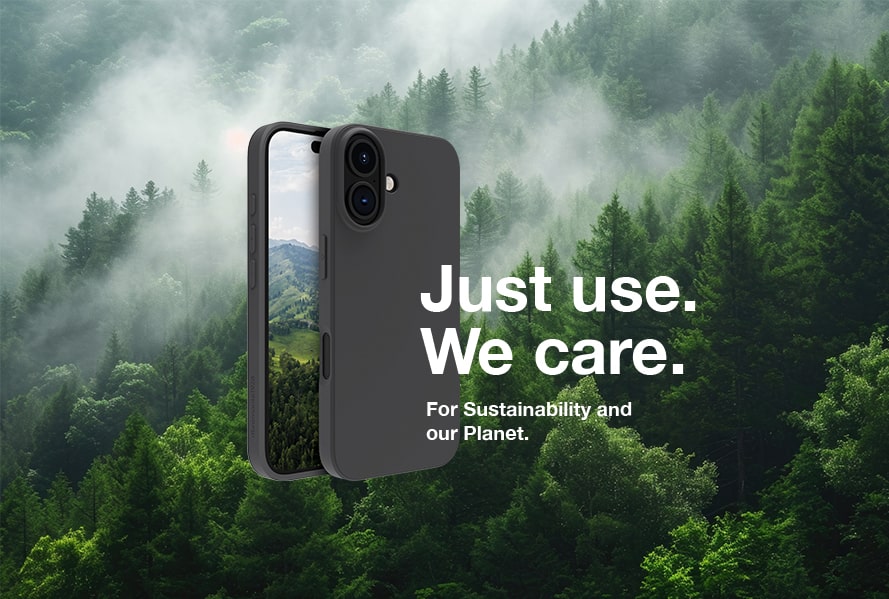
Just use. We care for Sustainability.
The TKD relies on sustainable logistics solutions and low-emission transport methods to minimize the CO₂ footprint throughout the entire supply chain.
The TKD is committed to fair working conditions along the entire value chain and only collaborates with certified partners.
Since October 1, 2024, the TKD has exclusively offered sustainable accessory products made from recycled materials to conserve resources.
The TKD optimizes energy consumption in its own IT infrastructure and relies on climate-friendly data centers.
Through buy-back and refurbishment programs, the TKD extends the LifeCycle of end devices and reduces electronic waste.
The TKD trains employees and customers in sustainable device management to establish resource-saving usage concepts in the long term.
Through reconditioning, we have saved an impressive 142,858,600 liters of water since 2018*. This corresponds to the annual water consumption of thousands of households and underscores our commitment to the responsible use of resources.
Since 2018, we have saved a total of 2,954,240 kilograms of raw material through sustainable processes**. By reusing valuable resources, we reduce the need for new production and make an important contribution to conserving natural resources.
Our sustainable measures have led to a saving of 3,039.93 tons of CO₂ since 2018***. This corresponds to the emissions a car would typically generate over more than 24 million kilometers – a significant step for climate protection.
Through our commitment to the circular economy, we have avoided 10,835.9 kilograms of electronic waste since 2018****. By giving devices a second life, we not only reduce waste but also the need for resource-intensive new production.
For our accessory solutions, we specifically focus on more sustainable materials and durable product concepts. From protective cases to chargers and display screen protectors, a large part of our portfolio consists of recycled or resource-saving materials. In doing so, we combine sustainability requirements with quality, everyday usability, and a long service life.
We understand sustainability not as an additional option, but as an integral part of modern workplace and device strategies.
Our DaaS procurement model has been recognized as the most sustainable. We are setting new standards with resource-saving solutions.

As a supporter of the United Nations Global Compact, TKD relies on responsible and resource-saving workplace and lifecycle concepts for businesses.

Our certifications in environmental, occupational, data, and information protection guarantee audited standards. Security and sustainability are firmly embedded in our processes.
Discover solutions for a flexible, secure, and future-oriented world of work.
*Assuming that the production of a new smartphone requires approximately 3,000 liters of water (Fraunhofer UMSICHT (2023), Water Consumption in Electronics Production) and TKD has brought around 47,600 smartphones into a second lifecycle from 2018 – 2024.
**Assuming that the production of a smartphone requires approximately 70 kg of raw materials (Fraunhofer UMSICHT (2023), Water Consumption in Electronics Production) and TKD has brought around 47,600 smartphones into a second lifecycle from 2018 – 2024.
***Assuming that the production of a new smartphone averages 55 kg of CO₂ equivalents (CO₂e) per device (Fraunhofer UMSICHT (2023), Water Consumption in Electronics Production) and TKD has brought around 47,600 smartphones into a second lifecycle from 2018 – 2024.
****Assuming that the reuse of smartphones avoids approximately 220 g of electronic waste per device (Fraunhofer UMSICHT (2023), Water Consumption in Electronics Production) and TKD has brought around 47,600 smartphones into a second lifecycle from 2018 – 2024.