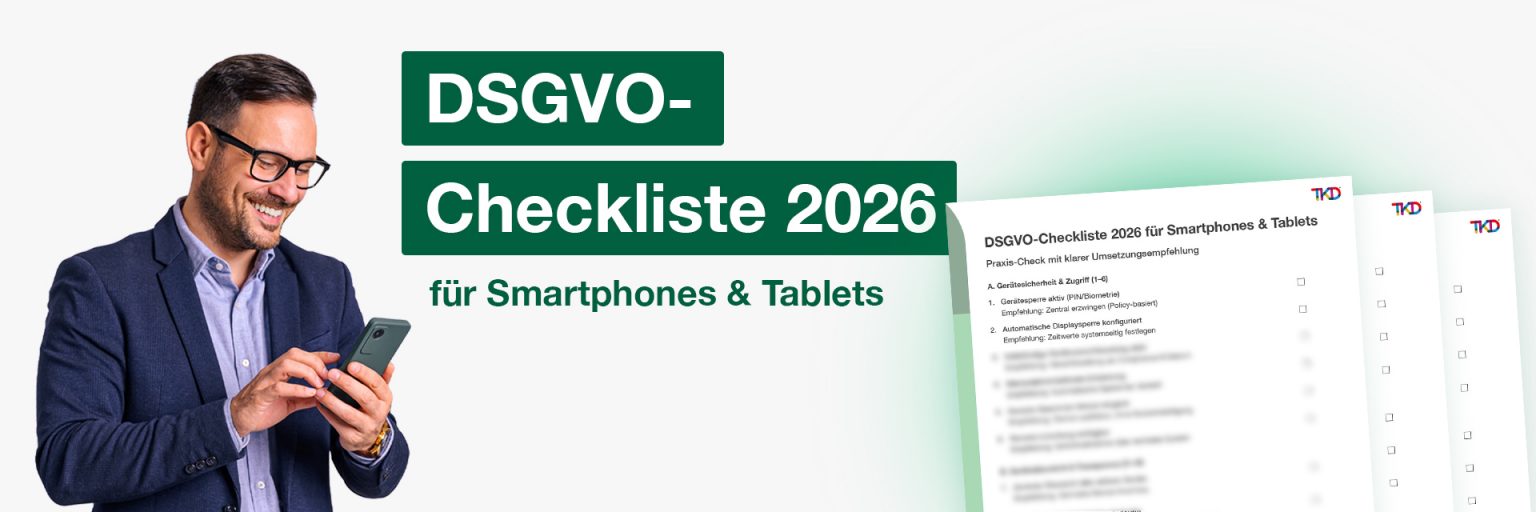
The 2026 Checklist – Classification, Practical Insights, and the Path to a Manageable Solution
Smartphones and tablets have become fully integrated business tools. They contain emails, contacts, calendars, access to business applications, and often sensitive customer or employee data.
At the same time, mobile devices in many companies are still not managed with the same level of structure and oversight as traditional IT workplaces.
Looking ahead to 2026, one thing is becoming increasingly clear:
GDPR-compliant device security is no longer a marginal issue — it is part of responsible corporate governance.
This article explains:
- where common misconceptions occur,
- which risks arise from them,
- which aspects companies should keep in mind,
- and why these requirements can only be implemented effectively in the long term through system-supported management across the entire device LifeCycle.
Why Mobile Devices Are an Underestimated GDPR Issue
The growing mobility of modern work brings clear advantages — but also new challenges:
- mobile working and home office environments
- cloud-based applications
- flexible device provisioning
- changing users and deployment locations
What is often underestimated:
Mobile devices are among the most common touchpoints for personal data — and at the same time among the most dynamic.
Loss, theft, private use, outdated software, or unclear offboarding processes frequently lead to data protection incidents. Not necessarily due to negligence, but because proper structures are missing.
GDPR & Mobile Devices – Understanding the Requirements
The GDPR does not define specific device types or systems.
However, it clearly requires:
- the protection of personal data
- appropriate technical and organizational measures
- consideration of the current state of technology
As soon as smartphones or tablets process personal data, they must be appropriately secured, managed, and controlled.
Guidance is provided by recommendations from the German Federal Office for Information Security (BSI) as well as the European Union Agency for Cybersecurity (ENISA).
While these recommendations are not mandatory for every company, in practice they are considered an important reference framework during audits and assessments.
Typical Misconceptions in Practice
In everyday business operations, similar assumptions repeatedly arise:
- “The data is stored in the cloud.”
→ Local synchronization, caches, and access permissions are often overlooked. - “We use screen locks.”
→ Without centralized control and response capabilities, that is not enough. - “Private use is allowed.”
→ Without technical separation, control can quickly be lost. - “The device still works.”
→ Missing security updates become a growing risk. - “We handle everything during employee offboarding.”
→ One of the most common weaknesses identified in audits.
These issues rarely create problems individually — but rather in combination.
From Checklist to Implementation: System-Supported Instead of Manual
This is exactly where Mobile Device Management (MDM) systems come into play.
MDM platforms do not treat the points listed in the checklist as isolated tasks, but rather as preconfigured technical standards:
- Security policies are centrally defined and automatically enforced
- Device status, updates, and compliance remain fully transparent
- Access rights can be managed or revoked
- Loss and offboarding scenarios are technically secured
The complexity does not disappear — it becomes centralized, standardized, and manageable.
TKD is happy to review your requirements free of charge and recommend a tailored solution. From simple system recommendations to full implementation and ongoing MDM support, we offer a broad portfolio as a partner of Samsung Knox, Microsoft Intune, Ivanti, and Jamf.
Why Lifecycle Management Is Essential
What matters is not only the active use of a device, but its entire lifecycle:
- provisioning
- usage
- replacement
- return
- data deletion
- reuse or disposal
Only when this lifecycle is structured and managed consistently can the risks described in the checklist be reliably avoided.
TKD’s lifecycle management is fully aligned with these processes and ensures both smart, digital lifecycle management for smartphones and tablets as well as the process stability required for GDPR compliance.
Conclusion: Security Comes Through Structure
The requirements for mobile devices are extensive — not because they are excessive, but because smartphones have become productive workplaces containing sensitive data.
The key question is therefore no longer:
“Do we need to address these topics?”
But rather:
“How do we organize them so they function reliably in the long term?”
System-supported MDM structures and holistic lifecycle management make exactly that possible:
They transform a large number of individual obligations into one controllable, transparent, and traceable overall process.
Looking toward 2026, this is no longer optional — it is a prerequisite for secure, efficient, and GDPR-compliant mobile work.